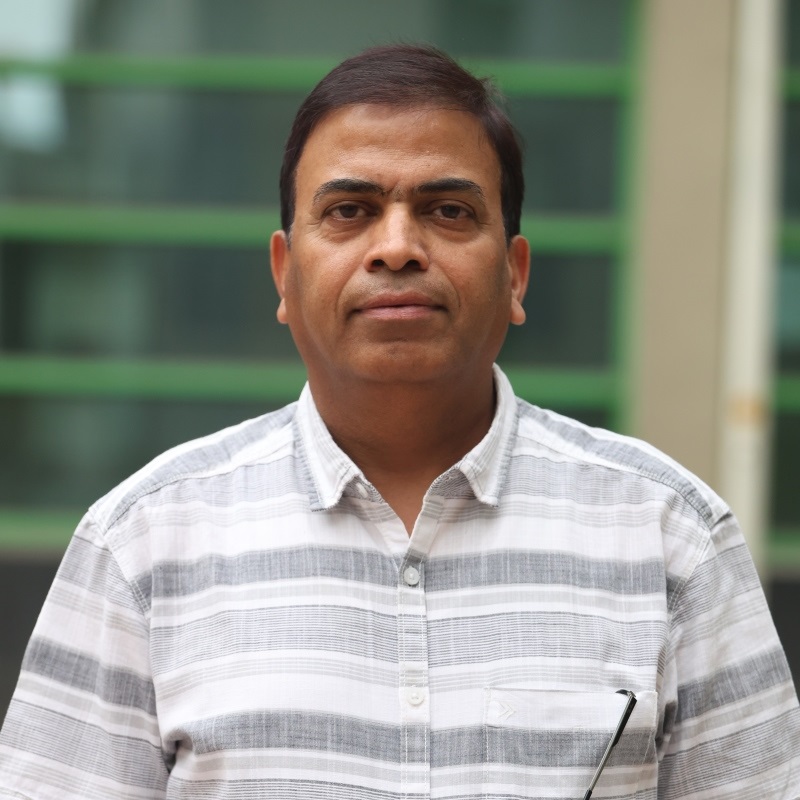
Prof. Navin Kumar is a Professor in the Department of Mechanical Engineering at the Indian Institute of Technology (IIT) Ropar, where he has been a faculty member since 2010. He received his Master’s degree in Mechanical Engineering from the Indian Institute of Technology Kharagpur, followed by a Ph.D. in Mechanical Engineering from the Indian Institute of Technology Delhi, specializing in advanced topics of mechanical systems and their applications. His academic training provided him with a strong foundation in mechanical sciences, which he further enriched through international research exposure. Prior to joining IIT Ropar, Dr. Kumar served as a Research Scientist at the Stevens Institute of Technology, New Jersey, USA, from 2007 to 2009. During this period, he worked on interdisciplinary projects in vibration, noise, and smart materials, contributing to applications in both engineering and biomedical fields. He also has industrial experience, having briefly worked as an Engineer at Goodyear Ltd. in 1997–1998, which gave him practical insights into real-world engineering challenges and their industrial solutions.
At IIT Ropar, Dr. Kumar began his academic career as an Assistant Professor in 2010, was promoted to Associate Professor in 2015, and has been serving as a Professor since November 2021. Over the years, he has played a pivotal role in teaching, mentoring, and conducting cutting-edge research in the areas of vibration and noise control, fault diagnosis and condition monitoring, and the biomechanics of hard and soft tissues. His expertise also extends to biomedical instrumentation, as well as the development of smart structures and advanced materials, making his research highly interdisciplinary in nature. Dr. Kumar’s work is characterized by a focus on solving complex engineering problems with real-world applications, particularly those at the intersection of mechanical engineering and biomedical sciences. His contributions not only advance fundamental understanding but also aim to improve technologies for healthcare, monitoring systems, and structural performance. Through his teaching, he has guided numerous undergraduate, postgraduate, and doctoral students, contributing significantly to capacity building in mechanical and biomedical engineering research.
Copyright © Department of Mechanical Engineering, Indian Institute of Technology Ropar, Punjab, INDIA
© Website Designed & Developed By ME Website Team, IIT Ropar