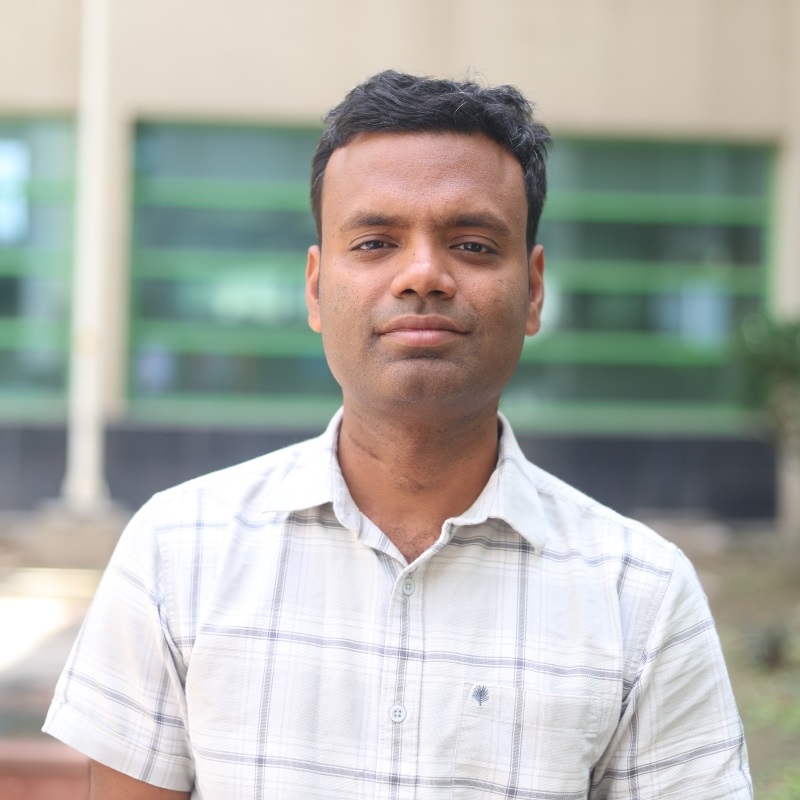

Dr. Manish Agrawal
Assistant Professor
PhD, Indian Institute of Science Bangalore, India
- Office: 417, Satish Dhawan Block, +91-1881-23-2379
- Specialization: Computational Mechanics
- Research Areas: Finite Element Analysis, Continuum Mechanics, Topology Optimization, Contact mechanics, Multiphysics Simulations, Applied Mechanics with deep learning
Dr. Manish Agrawal is an Assistant Professor in the Department of Mechanical Engineering at IIT Ropar. He earned his PhD from the Indian Institute of Science, Bangalore. His broad area of expertise lies in Mechanics and Design, with specialization in computational mechanics, including finite element analysis, continuum mechanics, topology optimization, contact mechanics, multiphysics simulations, and the application of deep learning to physical systems.
In teaching, Dr. Agrawal offers courses such as Finite Element Methods in Engineering, Applied Elasticity, Chaos in Dynamical Systems, and Deep Learning for Physical Systems. He has published work on electromechanical systems using hybrid finite elements, nonlinear elastodynamics, and including design/manufacturing constraints in topology optimization, among other topics.
Professional Achievements:
- To be updated
- Deep Learning for the Physical Systems
- Finite Element Methods in Engineering
- Multi-Body Dynamics (MBD)
- Vibration Analysis
- (1) D. S. Bombardea, M. Agrawal, S. S. Gautama, A. Nandy, Hellinger–Reissner principle based stress–displacement formulation for three-dimensional isogeometric analysis in linear elasticity, Computer Methods in Applied Mechanics and Engineering, [Accepted, under publication], 2022
- (2) M. Agrawal, A. Nandy, and C.S. Jog. A hybrid finite element formulation for large-deformation contact mechanics. Computer Methods in Applied Mechanics and Engineering, 356:407 – 434, 2019
- (3) M. Agrawal and C. S. Jog. Monolithic formulation of electromechanical systems within the contextof hybrid finite elements. Computational Mechanics, 59(3):443–457, 2017
- (4) M. Agrawal and C. S. Jog. A quadratic time finite element method for nonlinear elastodynamicswithin the context of hybrid finite elements.Applied Mathematics and Computation, 305:203–220, 2017
- (5) C. S. Jog, M. Agrawal, and A. Nandy. The time finite element as a robust general scheme for solving nonlinear dynamic equations including chaotic systems.Applied Mathematics and Computation,279:43–61, 2016
- To be updated
- To be updated